Generalized Geometry
This notebook show you how to assemble multiple non-modular detectors like JungFrau and ePix100.
[1]:
import multiprocessing as mp
import time

%matplotlib inline
import matplotlib.pyplot as plt
import numpy as np

from extra_data import RunDirectory
from pyfoamalgo.geometry import EPix100Geometry, JungFrauGeometry, stack_detector_modules
from pyfoamalgo import nanmean

mp.cpu_count()
[1]:
72
JungFrau Geometry
[2]:
# TODO: find a better sample run
run = RunDirectory("/gpfs/exfel/exp/XMPL/201750/p700000/raw/r0021")

run.info()
# of trains:    12307
Duration:       0:20:30.7
First train ID: 106739917
Last train ID:  106752223

0 detector modules ()

5 instrument sources (excluding detectors):
  - SA1_XTD2_XGM/XGM/DOOCS:output
  - SPB_IRDA_JNGFR/DET/MODULE_2:daqOutput
  - SPB_IRDA_JNGFR/DET/MODULE_6:daqOutput
  - SPB_IRDA_JNGFR/DET/MODULE_7:daqOutput
  - SPB_XTD9_XGM/XGM/DOOCS:output

6 control sources: (1 entry per train)
  - ACC_SYS_DOOCS/CTRL/BEAMCONDITIONS
  - SA1_XTD2_ATT/MDL/MAIN
  - SA1_XTD2_MIRR-1/MOTOR/HMRY
  - SA1_XTD2_XGM/XGM/DOOCS
  - SPB_IRDA_JNGFR/DET/CONTROL
  - SPB_XTD9_XGM/XGM/DOOCS
[3]:
_, train_data = run.train_from_index(0)
Assembling without a geometry file
Note: stack_detector_modules returns an array-like wrapper around the existing arrays which avoid the data copy.
[4]:
modules_data = stack_detector_modules(
    train_data, 'SPB_IRDA_JNGFR/DET/MODULE_*:daqOutput', 'data.adc', module_numbers=[1, 2, 3, 6, 7, 8])

modules_data.shape
[4]:
(1, 6, 512, 1024)
[5]:
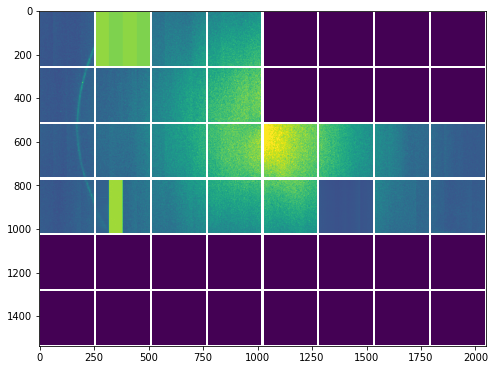
# The whole image will be assembled from 6 modules and the layout is 3 x 2.
geom = JungFrauGeometry(3, 2)
[6]:
n_pulses = modules_data.shape[0]

# Allocate the assembled image array and reuse it as far as possible to speed up data processing.
assembled = geom.output_array_for_position_fast(extra_shape=(n_pulses,), dtype=np.float32)
assembled.shape
[6]:
(1, 1536, 2048)
[7]:
t0 = time.perf_counter()

# Assemble modules and mask ASIC edge pixels.
geom.position_all_modules(modules_data, out=assembled, ignore_asic_edge=True)

print(f"Assembling a train with {n_pulses} pulses takes: {1e3 * (time.perf_counter() - t0):.1f} ms")
Assembling a train with 1 pulses takes: 10.6 ms
Note: nanmean implemented in pyfoamalgo is much faster than numpy.nanmean.
[8]:
t0 = time.perf_counter()

# Calculate the average (taking into account nan) of the assembled image.
assembled_mean = nanmean(assembled, axis=0)

print(f"Averaging a train with {n_pulses} pulses takes: {1e3 * (time.perf_counter() - t0):.1f} ms")
Averaging a train with 1 pulses takes: 13.8 ms
[9]:
_, ax = plt.subplots(figsize=(8, 8))

ax.imshow(assembled_mean, vmin=0, vmax=10000)
[9]:
<matplotlib.image.AxesImage at 0x2ac8a6b76510>
Assembling with a geometry file
[10]:
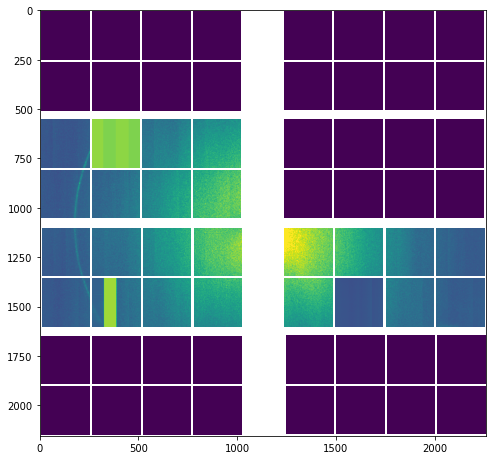
# Now we will have assemble 8 modules instead of 6.
modules_data = stack_detector_modules(
    train_data, 'SPB_IRDA_JNGFR/DET/MODULE_*:daqOutput', 'data.adc', module_numbers=[1, 2, 3, 4, 5, 6, 7, 8])
[11]:
geom = JungFrauGeometry.from_crystfel_geom('jungfrau8.geom', 4, 2)

assembled = geom.output_array_for_position_fast(extra_shape=(n_pulses,), dtype=np.float32)
assembled.shape
[11]:
(1, 2155, 2260)
[12]:
t0 = time.perf_counter()

# Assemble modules and mask ASIC edge pixels.
geom.position_all_modules(modules_data, out=assembled, ignore_asic_edge=True)

print(f"Assembling a train with {n_pulses} pulses takes: {1e3 * (time.perf_counter() - t0):.1f} ms")
Assembling a train with 1 pulses takes: 2.4 ms
[13]:
_, ax = plt.subplots(figsize=(8, 8))

assembled_mean = nanmean(assembled, axis=0)
ax.imshow(assembled_mean, vmin=0, vmax=10000)
[13]:
<matplotlib.image.AxesImage at 0x2acb08a2f650>
ePix100 Geometry
[ ]:
run = RunDirectory("")

run.info()
[ ]:
_, train_data = run.train_from_index(100)
[ ]:
modules_data = stack_detector_modules(
    train_data, 'MID_EXP_EPIX-*/DET/RECEIVER:daqOutput', 'data.image.pixels', module_numbers=[1, 2])

# ePix100 is a train-resolved detector
modules_data.shape
Stack modules without a geometry file
[ ]:
# The whole image will be assembled from 2 modules and the layout is 2 x 1.
geom = EPix100Geometry(2, 1)
[ ]:
# Allocate the assembled image array and reuse it as far as possible to speed up data processing.
assembled = geom.output_array_for_position_fast(dtype=np.float32)
assembled.shape
[ ]:
t0 = time.perf_counter()

# Assemble modules and mask ASIC edge pixels.
geom.position_all_modules(modules_data, out=assembled, ignore_asic_edge=True)

print(f"Assembling a train with {n_pulses} pulses takes: {1e3 * (time.perf_counter() - t0):.1f} ms")
[ ]:
_, ax = plt.subplots(figsize=(4, 8))

ax.imshow(assembled)